
Short answer: Yes, in the ways that count. When you build endurance, your legs ask for every breath, and your lungs answer with deep, steady breaths. Those breaths keep your lungs supple. Fitter people lose lung power more slowly as they age, sleep better, and have a much lower risk of heart attack and stroke.
The short version
- Running is active: your legs demand every breath, and heart, legs and lungs train together.
- Deep breaths on a run keep the lungs supple, and fitter people lose lung power more slowly as they age — a 20-year study of 3,332 adults showed this.
- In studies, the benefit of aerobic exercise lasted after people stopped; breathing training alone did not.
- Across 1.4 million people, the fittest had 42% lower risk of stroke than the least fit.
World Lung Day, in two lines
Today is World Lung Day. In the Times of India, a Nagpur lung specialist, Dr Sushant Meshram, called lung health “a window to the health of the whole body”, and warned that sitting still feeds “a cycle of breathlessness and declining exercise capacity”. Here is how to break that cycle.
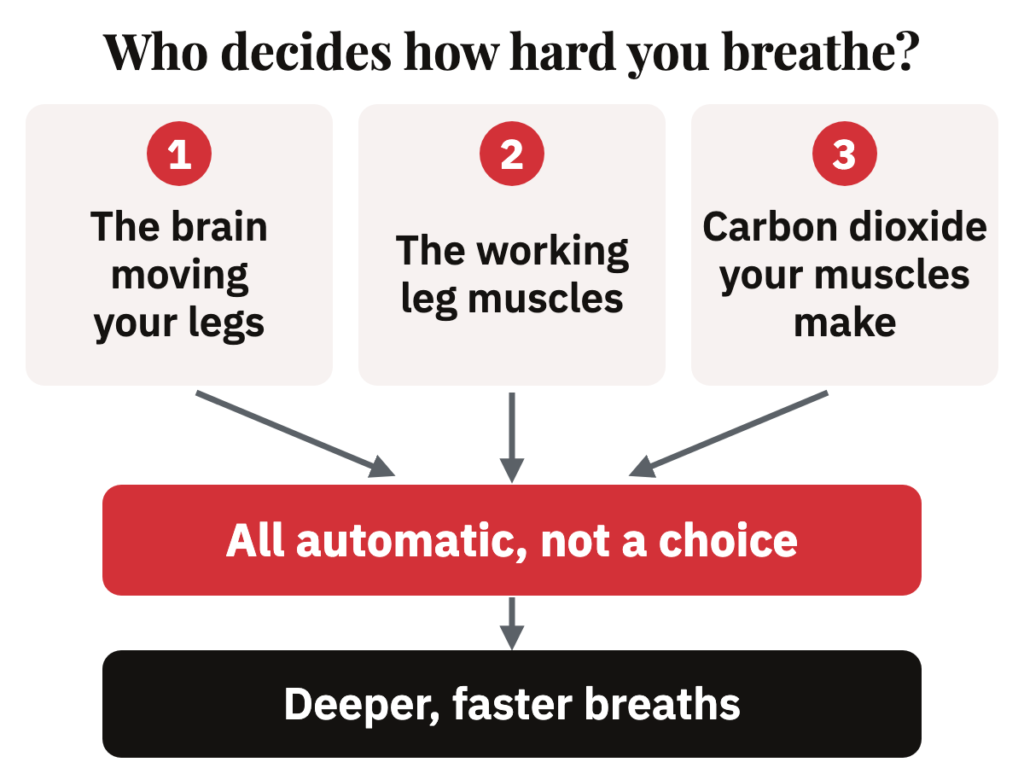
Who decides how hard you breathe on a run?
Not you. When you start to jog, you do not think “breathe faster now”. It just happens. Three things drive it, all automatic: a signal from the part of your brain that moves your legs, signals from the working leg muscles, and the carbon dioxide your muscles make (Dempsey and colleagues, 2022). Your legs are in charge.
When scientists blocked the nerve signals coming from the leg muscles, people breathed too little while they exercised (Dempsey and colleagues, 2014). So on a run, breathing is not a choice. Speed up, and the breaths get deeper and faster. Slow down, and they settle. Every step, every minute.
Why sitting and breathing is not the same
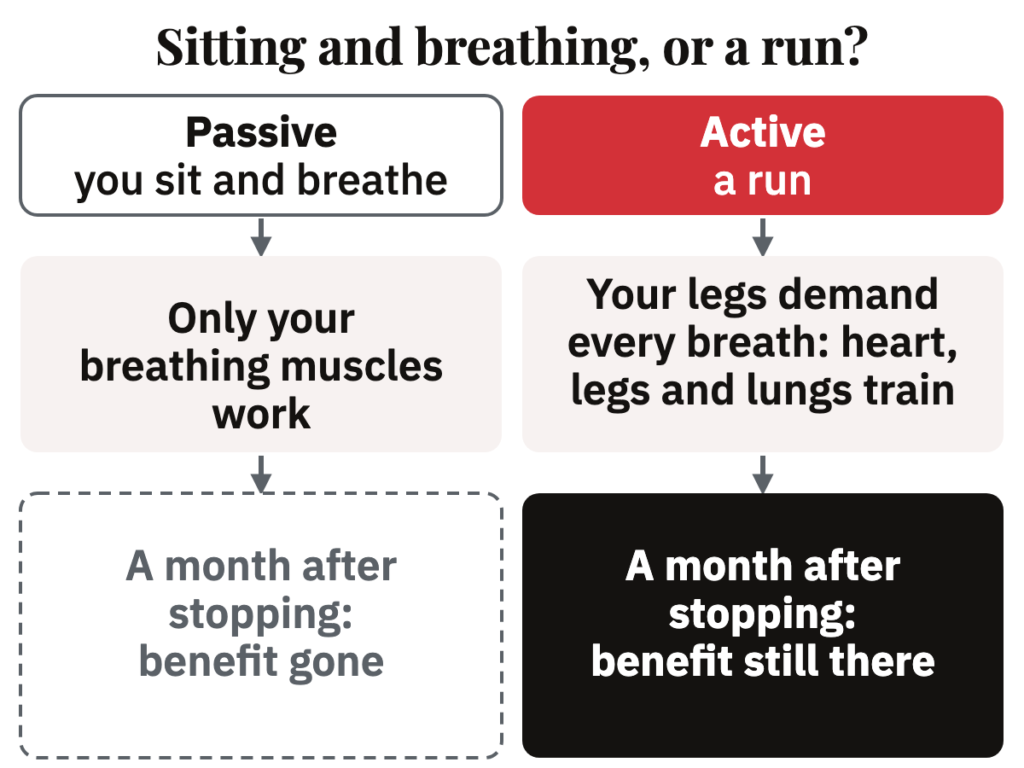
Breathing exercises are good. But they are passive: you sit, you breathe on purpose, and only your breathing muscles work. A run is active: your legs demand every breath, and your heart, legs and lungs all train together.
The difference shows when people stop. In one study, breathing-muscle training and brisk exercise lowered blood pressure by about the same amount. A month after stopping, only the exercise group still had the benefit (Jae and colleagues, 2025). In another, people with asthma did aerobic training or breathing exercises. Three months later, the aerobic group was 2.6 times more likely to be doing better (Evaristo and colleagues, 2020).
Do deep breaths really help the lungs?
Yes. When you breathe shallowly, some of the tiny air sacs in your lungs partly close. A big breath — twice the normal size or more — opens them up again and makes the lung easier to stretch (Severs and colleagues, 2022). The stretch also tells the lung to release its natural lining, which helps the air sacs open easily (Edwards, 2001). A steady run gives your lungs hundreds of those deep breaths.
Does staying fit protect your lungs as you age?
Everybody’s lungs lose a little every year. Staying fit slows that. A US study followed 3,332 young adults for 20 years. The fitter they were, the more slowly their lungs lost power. People who let their fitness slip lost lung power faster (Benck and colleagues, 2017).
In Finland, the most active men lost lung power more slowly over 25 years, whether they smoked or not (Pelkonen and colleagues, 2003). Older endurance athletes had bigger, stronger lungs than expected for their age (Hagberg and colleagues, 1988). Not smoking is still the biggest step. But moving helps.
How does breathing calm your heart?
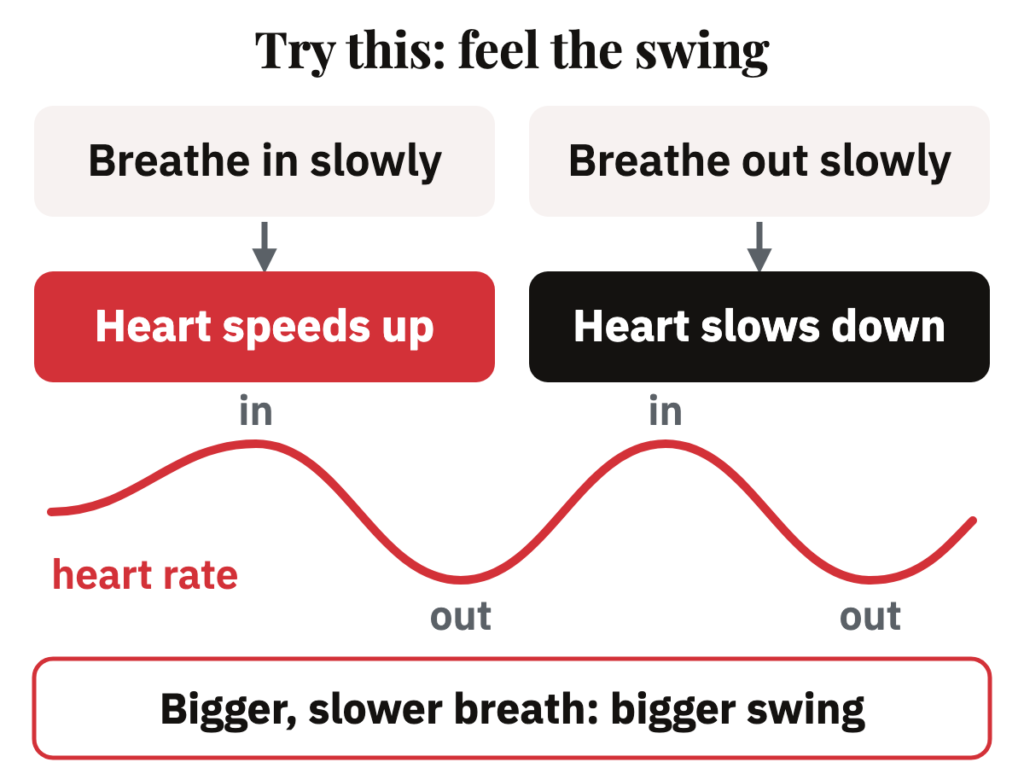
Your lungs and heart are connected by a nerve called the vagus. It is your “rest and repair” nerve. Try this. Put two fingers on your pulse and breathe in slowly. Your heart speeds up a little.
Breathe out slowly. It slows down. That small up-and-down is called heart rate variability. The bigger and slower the breath, the bigger the swing (Hirsch and Bishop, 1981).
Building endurance makes this nerve stronger even when you are resting. In 16 studies of healthy adults, training raised the calming signal from the vagus (Amekran and El Hangouche, 2024). And sleep? In a 12-week study of adults over 40 who slept badly, regular brisk exercise improved their sleep and their calming vagal signal together (Tseng and colleagues, 2020). Run, sleep well, and the two help each other.
Heart attack and stroke
This is where fitness pays off most. Stroke. Across 1.4 million people, the fittest had 42% lower risk of stroke than the least fit (Wang and colleagues, 2020).
- Getting fitter counts. Every step up in fitness meant 9% lower risk of the most common kind of stroke (Ehrman and colleagues, 2023).
- Heart attack. Every step up in fitness — about 1 km/h faster at an easy jog — meant 15% lower risk of heart attack and other heart and blood-vessel problems (Kodama and colleagues, 2009).
So what should you do? Build endurance, slowly
- Start where you are. A brisk walk counts.
- Go a little further each week, not a lot further.
- Let your breathing be your guide. If you can talk in short sentences, the pace is right for most of your runs.
- Keep going. Fitness fades if you stop for long, so make it a habit, not a project.
- Get checked first if you have chest pain, get unusually breathless, or have a heart condition.
Your lungs will thank you on every run. Your heart will thank you for years.
Your questions, answered
Does running increase lung capacity?
It helps in the ways that count. Deep breaths on a run keep the lungs supple, and fitter people lose lung power more slowly as they age — a 20-year study of 3,332 adults showed this. Your breathing also gets more efficient, so the same pace needs less air.
Why do I get breathless on a run?
Because your leg muscles are asking for more oxygen, and your brain answers by making you breathe harder. It is automatic. As you build endurance, you need less air for the same pace. Sudden or unusual breathlessness, or chest pain, is different — stop and see a doctor.
Are breathing exercises as good as running for the lungs?
They help, but they are passive: you sit and breathe, and only the breathing muscles work. Running is active: your legs demand every breath, and heart, legs and lungs train together. In studies, the benefit of aerobic exercise lasted after people stopped; breathing training alone did not.
Does running lower the risk of stroke?
Yes. Across 1.4 million people, the fittest had 42% lower risk of stroke than the least fit (Wang and colleagues, 2020). Getting fitter counts too: every step up in fitness lowered the risk of the most common kind of stroke by 9% (Ehrman and colleagues, 2023).
Does running help me sleep?
Yes, for most people. In a 12-week study of adults over 40 who slept badly, regular brisk exercise improved sleep and the heart’s calming vagal signal together (Tseng and colleagues, 2020). Run, sleep well, and the two help each other.
Run with us
Find your next event, and people to train with, at www.TelanganaRunners.com. Telangana Runners, 7B Journalist Colony, Film Nagar, Jubilee Hills, Hyderabad, Telangana 500096. The medical side of this story, with all the studies, is on the Cardiac Rehab blog: Can exercise make your lungs work better for your heart?
References
- The Times of India, Nagpur, 25 Sep 2026 — Healthy lungs vital for heart, brain and overall well-being: Experts. timesofindia.indiatimes.com/city/nagpur/healthy-lungs-vital-for-heart-brain-and-overall-well-being-experts/articleshow/134469394.cms
- Dempsey JA, et al. The physiology and pathophysiology of exercise hyperpnea. Handb Clin Neurol 2022. doi.org/10.1016/B978-0-323-91534-2.00001-1
- Dempsey JA, Blain GM, Amann M. Are type III-IV muscle afferents required for a normal steady-state exercise hyperpnoea in humans? J Physiol 2014. doi.org/10.1113/jphysiol.2013.261925
- Jae SY, et al. Comparison of inspiratory muscle strength and aerobic exercise training and detraining on blood pressure in hypertensive patients. Clin Hypertens 2025. doi.org/10.5646/ch.2025.31.e15
- Evaristo KB, et al. Effects of aerobic training versus breathing exercises on asthma control. J Allergy Clin Immunol Pract 2020. doi.org/10.1016/j.jaip.2020.06.042
- Severs LJ, Vlemincx E, Ramirez JM. The psychophysiology of the sigh: I. Biol Psychol 2022. doi.org/10.1016/j.biopsycho.2022.108313
- Edwards YS. Stretch stimulation: its effects on alveolar type II cell function in the lung. Comp Biochem Physiol A 2001. doi.org/10.1016/s1095-6433(01)00321-x
- Benck LR, et al. Association between cardiorespiratory fitness and lung health from young adulthood to middle age. Am J Respir Crit Care Med 2017. doi.org/10.1164/rccm.201610-2089OC
- Pelkonen M, et al. Delaying decline in pulmonary function with physical activity: a 25-year follow-up. Am J Respir Crit Care Med 2003. doi.org/10.1164/rccm.200208-954OC
- Hagberg JM, et al. Pulmonary function in young and older athletes and untrained men. J Appl Physiol 1988. doi.org/10.1152/jappl.1988.65.1.101
- Hirsch JA, Bishop B. Respiratory sinus arrhythmia in humans: how breathing pattern modulates heart rate. Am J Physiol 1981. doi.org/10.1152/ajpheart.1981.241.4.H620
- Amekran Y, El Hangouche AJ. Effects of exercise training on heart rate variability in healthy adults. Cureus 2024. doi.org/10.7759/cureus.62465
- Tseng TH, et al. Effects of exercise training on sleep quality and heart rate variability in middle-aged and older adults with poor sleep quality. J Clin Sleep Med 2020. doi.org/10.5664/jcsm.8560
- Wang Y, et al. Cardiorespiratory fitness as a quantitative predictor of the risk of stroke. J Neurol 2020. doi.org/10.1007/s00415-019-09612-6
- Ehrman JK, et al. Improved cardiorespiratory fitness is associated with lower incident ischemic stroke risk. J Stroke Cerebrovasc Dis 2023. doi.org/10.1016/j.jstrokecerebrovasdis.2023.107240
- Kodama S, et al. Cardiorespiratory fitness as a quantitative predictor of all-cause mortality and cardiovascular events. JAMA 2009. doi.org/10.1001/jama.2009.681