


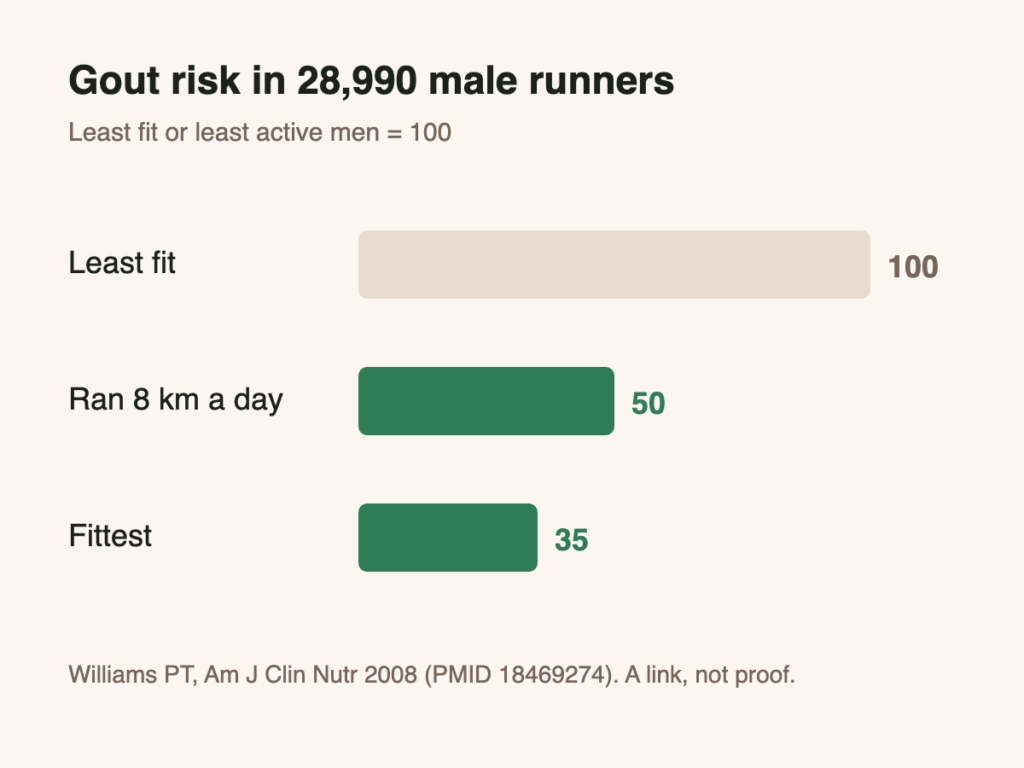
Short answer: Party last night, big toe on fire this morning? That is often gout. Did you know runners get gout less? In 28,990 male runners, those who ran 8 km a day had half the risk of gout, and building endurance is how to get there.
The short version
- Men who ran 8 km a day had 50% lower risk of gout; the fittest had 65% lower risk.
- A fit body uses insulin better, and the kidneys clear more uric acid.
- Gout is uric acid crystals inside a joint, most often the big toe.
- More than two to four drinks in a day raised the risk of an attack about 1.5 times; a meat-heavy two days, almost 5 times.
- Attacks were 2.4 times more likely between midnight and 8 am.
Yes, runners get gout less
The most useful number for prevention comes from runners. 28,990 male runners were followed for almost eight years. Compared with the least active or least fit men, those who ran 8 km or more a day had 50% lower risk of getting gout, and the fittest had 65% lower risk. Being lighter explained part of it.
How fitness lowers uric acid
Uric acid leaves the body mainly through the kidneys. In 133 people with gout, the kidneys cleared less uric acid when insulin was working poorly (insulin resistance). Regular aerobic exercise helps insulin work better, so the kidneys can clear more.
Weight is the other part. In a study of 47,150 men, men who lost 4.5 kg or more had 39% lower risk of gout. Very heavy men had about three times the risk of men at a healthy weight.
One honest note. These studies show a link, not proof. The one trial of weight loss in people who already have gout found no difference in attacks over its follow-up. So exercise is about lowering your risk over years, alongside your doctor’s treatment, not a quick fix for an attack.
What is gout?
Gout is a kind of arthritis. When there is too much uric acid in the blood, it can form sharp, needle-like crystals inside a joint, and the body attacks them. That is the sudden heat, redness and swelling (Dalbeth, Lancet 2021).
The big toe joint is gout’s favourite place. A review of why gout targets the foot points to the toe being cooler than the rest of the body, small knocks while walking, and wear in that joint. All three help crystals form there, which is why the first attack so often lands in the toe.
The party is the spark
Gout attacks rarely come out of nowhere. In a study of 724 people with gout, more than two to four drinks in the previous day raised the risk of an attack about 1.5 times. Wine, beer and spirits all counted. Food matters too. In a second study from the same group, people who ate the most purine-rich food over two days, mostly meat and seafood, had almost five times the risk of an attack.
Timing adds to it. Attacks were 2.4 times more likely between midnight and 8 am than in the daytime, even in people who had not been drinking. A late party, a heavy meal and a night’s sleep line up to make the morning the worst time.
How an attack is treated
An attack is treated with medicines that calm the swelling, chosen by your doctor. If attacks keep coming, for example two or more a year, the American College of Rheumatology guideline recommends tablets that lower uric acid, with a target below 6 mg/dL. Do not start or stop these on your own.
Run steady, not hard
The runners’ study was about regular distance and fitness built over years, not one hard race. Building endurance with easy, steady running most days of the week builds the fitness that went with lower risk. If you already have gout, ask your doctor before you start. The heart side of this story is on the Cardiac Rehab blog: gout after a party.
Your questions, answered
Do runners really get gout less?
In 28,990 male runners followed for almost eight years, those who ran 8 km or more a day had 50% lower risk of gout, and the fittest had 65% lower risk (Williams 2008). Being lighter explained part of this. It is a link seen over years, not proof from a trial, but it points the same way.
How does running help with uric acid?
The kidneys clear uric acid less well when insulin works poorly (Perez-Ruiz 2015). Regular aerobic exercise helps insulin work better. Losing weight helps too: men who lost 4.5 kg or more had 39% lower risk (Choi 2005).
Why does gout hit after a party?
More than two to four drinks in a day raised the risk of an attack about 1.5 times (Neogi 2014), and a meat-heavy two days almost 5 times (Zhang 2012). Attacks also tend to start between midnight and 8 am, so the morning after a party is the classic time.
Can I run during a gout attack?
No. A hot, swollen joint needs rest and treatment, so stop and see your doctor. Go back to easy running once the attack has settled and your doctor agrees. Start shorter and slower than before, and build up over a few weeks.
Build Your Endurance Now
Easy, steady running most days builds the fitness that went with half the risk of gout. Start slow and keep it regular. Read the heart side on Cardiac Rehab: gout after a party.
References
- Williams PT. Effects of diet, physical activity and performance, and body weight on incident gout in ostensibly healthy, vigorously active men. Am J Clin Nutr. 2008. pubmed.ncbi.nlm.nih.gov/18469274
- Perez-Ruiz F, et al. Renal clearance of uric acid is linked to insulin resistance and lower excretion of sodium in gout patients. Rheumatol Int. 2015. pubmed.ncbi.nlm.nih.gov/25763991
- Choi HK, Atkinson K, Karlson EW, Curhan G. Obesity, weight change, hypertension, diuretic use, and risk of gout in men. Arch Intern Med. 2005. pubmed.ncbi.nlm.nih.gov/15824292
- Christensen R, et al. Weight loss for people with gout and overweight or obesity: a randomized trial. Arthritis Rheumatol. 2024. pubmed.ncbi.nlm.nih.gov/38169151
- Dalbeth N, Gosling AL, Gaffo A, Abhishek A. Gout. Lancet. 2021. pubmed.ncbi.nlm.nih.gov/33798500
- Roddy E. Revisiting the pathogenesis of podagra: why does gout target the foot? J Foot Ankle Res. 2011. pubmed.ncbi.nlm.nih.gov/21569453
- Neogi T, et al. Alcohol quantity and type on risk of recurrent gout attacks: an internet-based case-crossover study. Am J Med. 2014. pubmed.ncbi.nlm.nih.gov/24440541
- Zhang Y, et al. Purine-rich foods intake and recurrent gout attacks. Ann Rheum Dis. 2012. pubmed.ncbi.nlm.nih.gov/22648933
- Choi HK, et al. Nocturnal risk of gout attacks. Arthritis Rheumatol. 2015. pubmed.ncbi.nlm.nih.gov/25504842
- FitzGerald JD, et al. 2020 American College of Rheumatology Guideline for the Management of Gout. Arthritis Care Res. 2020. pubmed.ncbi.nlm.nih.gov/32391934